- Myths of Technology
- Posts
- How AI is Bringing Back the Witch Hunt
How AI is Bringing Back the Witch Hunt
Exploring how AI is not a neutral tool, problems with its anthropomorphism, and how to stop the AI witch hunt

Komalika Neyol
January 21, 2026
I still remember hosting a Twitter space in early 2022 with my manager. We had a heavy discussion around a study I had read on the rise of female AI assistants. The problem looked bad back then, but now it looks worse.
We’re not only surrounded by feminine assistants like Siri, Alexa, and Cortana, but AI girlfriends dominate as one of the most popular use cases of AI. More women than ever absolutely hate AI and boycott its use, which might actually be affecting their careers.
So how did we reach here? Why is AI not as “neutral” as most tech influencers claim it to be? And most importantly, what’s next from here?
A Brief History of AI
The earliest mentions of AI date back to Greek mythology, where Talos, a bronze automaton built by Hephaestus, protected Crete. Pygmalion's ivory statue was brought to life by Aphrodite. Medieval alchemists also pursued the Takwin, a synthetic life form created in the laboratory.
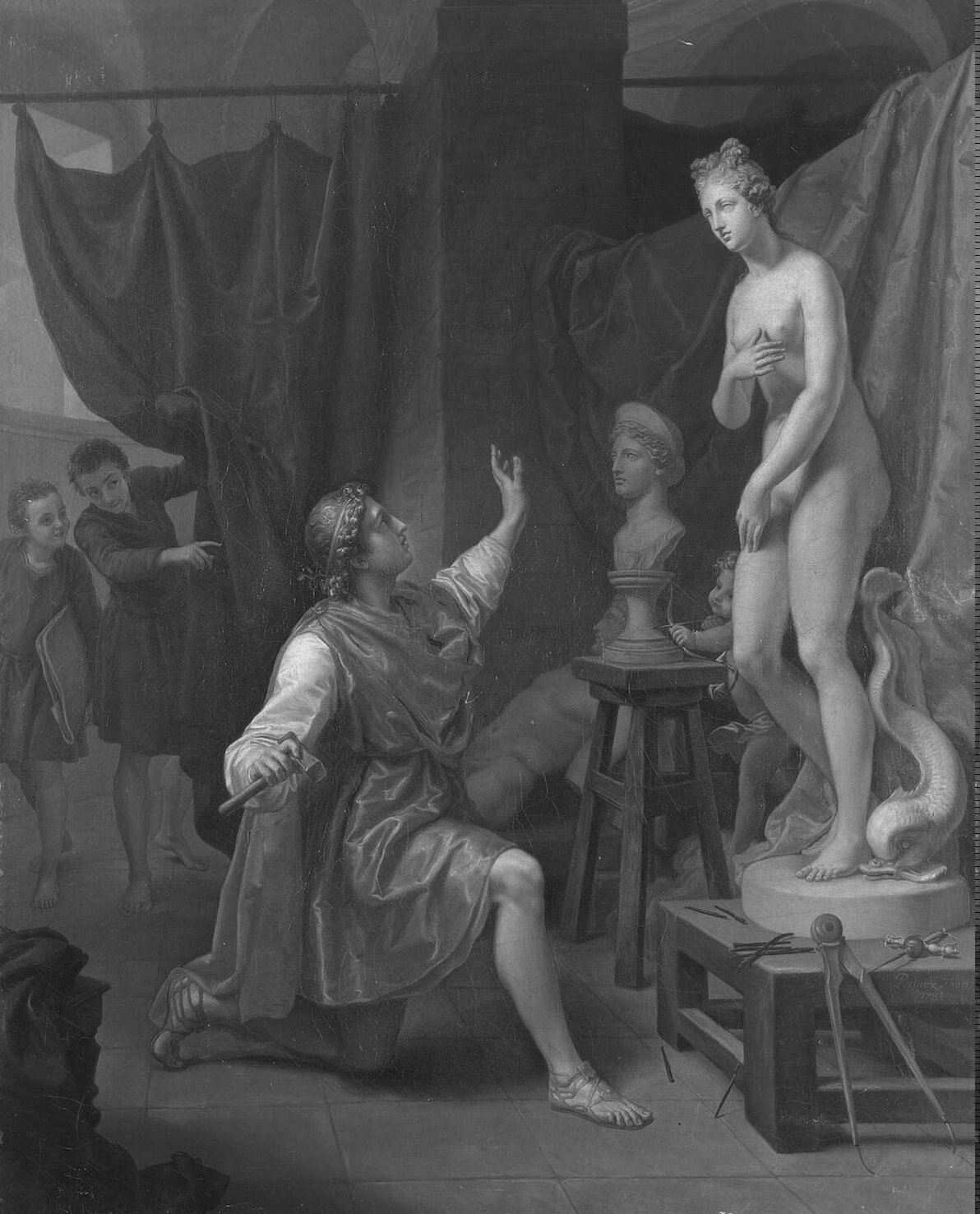
"Pygmalion and Galatea" by Laurent Pêcheux shows the Greek myth where sculptor Pygmalion falls in love with his own creation, a statue so perfect that the goddess Aphrodite brings it to life. (Courtesy: wikimedia)
However, it wasn't until the 1940s that fantasy began approaching reality.
Warren McCulloch and Walter Pitts published their paper on artificial neurons, proving mathematically how biological neurons could be replicated through circuits and logic gates.
In 1950, Alan Turing published his paper "Computing Machinery and Intelligence," proposing what became known as the Turing Test.
The field became really popular in 1956 when John McCarthy coined the term "artificial intelligence" at the Dartmouth Summer Research Project. This, of course, led him to successfully lobby for funding by framing it as a bounded problem that could be solved within a few months.
Since then, AI has seen various AI booms and winters. It was 1997, when Deep Blue defeated the Grandmaster Kasparov at chess, which proved machines could outthink humans in narrow domains.
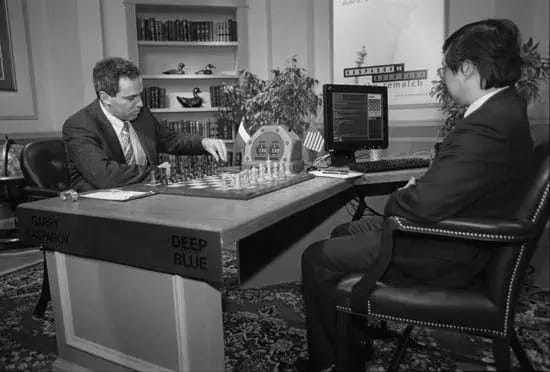
Kasparov vs Deep Blue Chess Match marks the moment when IBM's supercomputer publicly defeated the World chess champion Garry Kasparov. For centuries, chess represented the pinnacle of human intellectual, requiring intuition, creativity, and strategic thinking. Deep Blue's victory shattered that illusion. (Courtesy: britannica)
Then came a series of dramatic moments. IBM's Watson won Jeopardy in 2011. Geoffrey Hinton's team won the ImageNet competition using a deep convolutional neural network called AlexNet in 2012. DeepMind's AlphaGo defeated world champion Lee Sedol at the ancient game of Go in 2016. And finally, OpenAI released ChatGPT in 2022.
Now, notice how AI has always been understood as what we want it to be instead of what it actually is.
The Game is Rigged
Even the earliest imaginations of AI are loaded with anthropomorphism. It has always been attributed with human characteristics or behaviour. Mythology gave it attributes of protection and love (also notice how the masculine figure Talos is attributed the role of protection, and Pygmalion’s possessive nature towards women is considered acceptable). Its definition gave it attributes of “intelligence”. And now, it is attributed with everything from creativity and sentience to intention and even moral judgment.
The rise of feminine AI assistants didn't happen by accident.
Behind every Siri, Alexa, and Cortana was the psychology of comfort. Research consistently shows people find feminine voices more pleasant, approachable, and trustworthy in initial interactions. But companies leverage this ruthlessly, which directly translates to more user engagement and more data harvested.
For decades, receptionists, secretaries, and customer service roles were feminized and underpaid. One of the reasons why feminine assistants feel familiar is because they replicate the gendered service work women have always performed. By making AI feminine, companies tap into a deep cultural expectation that women should be helpful, available, patient, and emotionally intelligent.
The worst part, a heavily-male dominated industry finds feminine presence easier to dismiss. When an AI chatbot fails, there's an implicit understanding that machines can't be held responsible. But when it is a female AI chatbot, the failure also reinforces the gender bias that women are less competent, which paradoxically reduces pressure on the company.
AI is doing to our minds what processed food did to our bodies, porn did to intimacy, and social media did to our communities. It’s a slow death. We’re frogs in the boiling water.
The Witch Hunt Is Back
During the witch hunt era from the 15th to 18th centuries, around 60,000 women were executed in Europe. Many were midwives, herbalists, healers, and knowledge keepers who understood medicine, plants, and the body in ways that threatened emerging male-dominated medical institutions.

"Execution of Bridget Bishop at Salem, 1692" by Joseph Boggs Beale depicts the first woman hanged during the Salem witch trials. She was condemned based on spectral evidence, which means testimony by accusers who claimed to perceive invisible forces. (Courtesy: thecollector)
When the printing press emerged, women writers were published under male pseudonyms or their brothers' names. The Brontë sisters used the masculine pseudonyms Currer, Ellis, and Acton Bell. Mary Shelley's Frankenstein was initially published anonymously. Lise Meitner's calculations were fundamental to nuclear fission, but Otto Hahn got the Nobel Prize.
Now we're watching it happen with AI. Women's photos and voices are scraped without consent and fed into systems to generate explicit content, AI girlfriends, and deepfake porn. And this content is being generated much faster than any platform can remove it.
The venture capitalists funding these companies understand all of this. So the choice of feminine AI is a feature, not a side effect of “democratization”.
What Actually Needs to Change
Real change won't be easy. Regulation will need to catch up. Companies will need consequences for creating non-consensual deepfakes. The VC ecosystem will need to change its composition and incentive structure. Collectively, we'd need to decide that user growth isn't worth the cost to women's dignity and safety.
And it will take time. But here's what you can do right now:
Understand the system.
Read AI ethics literature. Follow researchers raising concerns. Learn whose data built these models and whose interests they serve. Be the person who knows the right questions to ask.
If you’re subscribed to this newsletter, you’ve already taken the first step. If not, it’s still not too late.
Demand better incentives.
The venture capital world remains overwhelmingly male. But Replika, built by a woman, proved that female founders aren't a solution if the incentive structure stays the same. What matters is if you’re optimizing for just engagement or genuine good.

If you're looking to build and want to work on something that doesn't exploit people, hit me up and let's work on your GTM together. The world needs founders asking better questions.
Stop anthropomorphizing AI.
Companies want you to anthropomorphize AI because it makes you trust it more and complain about it less. Resist this actively. Call it what it is. A tool trained on data you didn't consent to having used, designed by people with conflicts of interest. Stop talking to it like it has feelings. Stop attributing motives to it. This mental shift is harder than it sounds because companies have invested billions in making it feel natural.
Call out AI companies.
Right now, regulation lags years behind deployment. AI companies currently operate with almost no real constraints. Elon’s Grok was literally generating sexual deepfakes of women, stripping their clothes, and helping people harass millions on the platform. ChatGPT helped teenagers commit suicide. Google’s Gemini was generating racist images on its launch. And there are hundreds of small startups built specifically for AI deepfake porn. It’s fucked up. Literally. Call them out. Report them. Hold people accountable.
Share this with a friend.
More people need to see this. You know it too.
The world won't change because we play our part. The world will change because enough of us stop accepting that this is inevitable. That's a different thing entirely.
And that's the change worth fighting for.
Reply